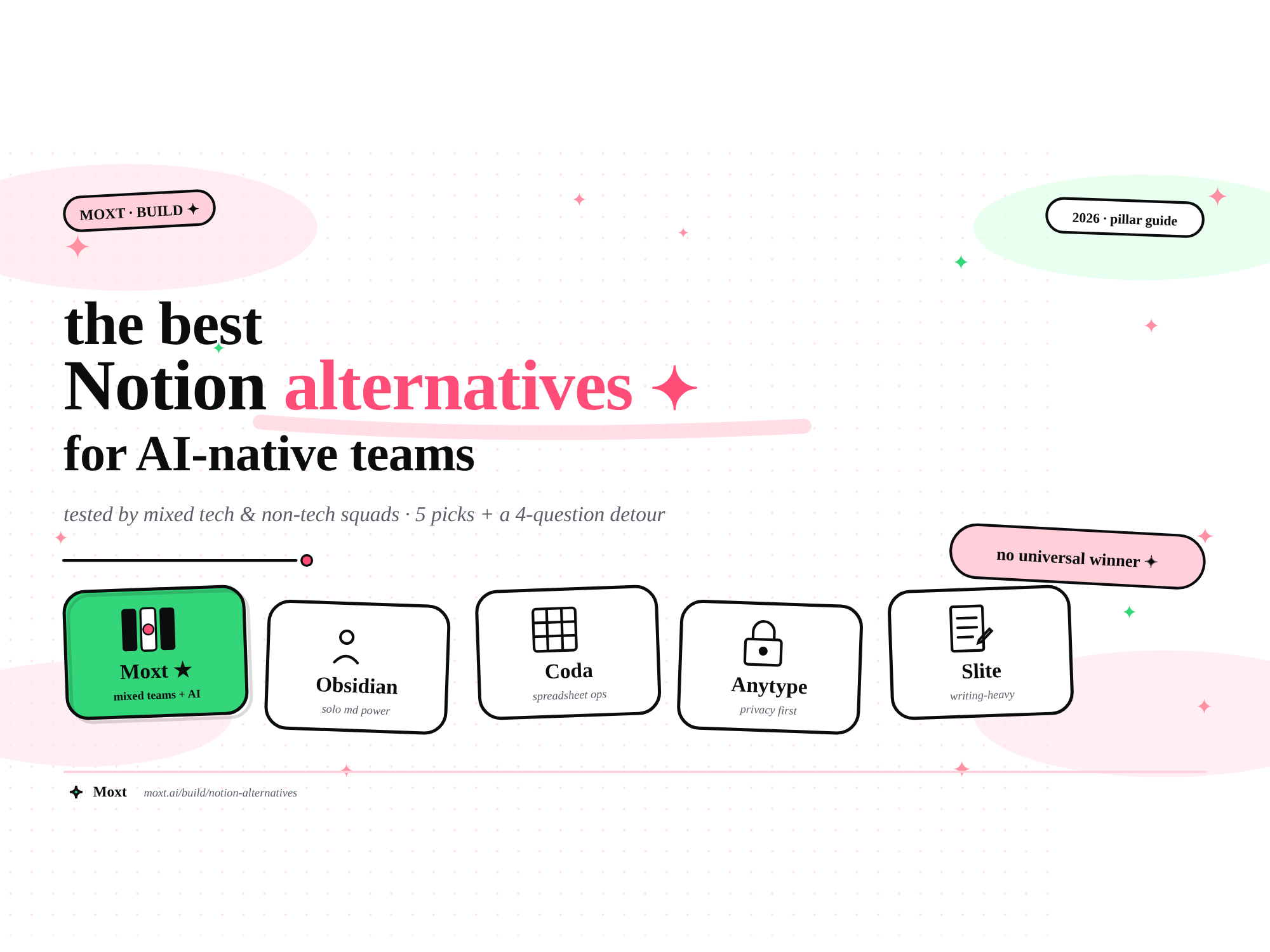
The best Notion alternatives for an AI-native team in 2026 are workspaces where technical teammates, non-technical teammates, and AI agents share the same surface — not document tools with an AI sidebar bolted on.
Why "Notion alternatives" is the question of 2026
For five years, the answer to "what should our team use to write things down?" was Notion. That conversation is reopening for one reason: AI agents are no longer a sidebar feature. They are the third member of the team.
If your agent can read your repo, draft a release note, and push a deploy to GitHub, the question is no longer "where do we store docs?" It is "where do my engineers, my non-engineers, and my AI agents all do their work without copy-pasting between three apps?"
Notion was built for the first question and is being asked the second. Searches for notion alternatives (1,900/mo) and notion alternative (1,000/mo) hold ~2,900/month combined in the US (Semrush, May 2026). The long-tail notion ai alternative (50/mo) is climbing — people who already pay for Notion AI and are still searching, which is the most useful signal in the dataset.
This article ranks five real options and ends with a four-question decision tree. We follow Google Search Central's Helpful, Reliable, People-First Content guidance — first-hand experience first, sources cited inline.
The Notion-shaped hole: when docs and code stop talking
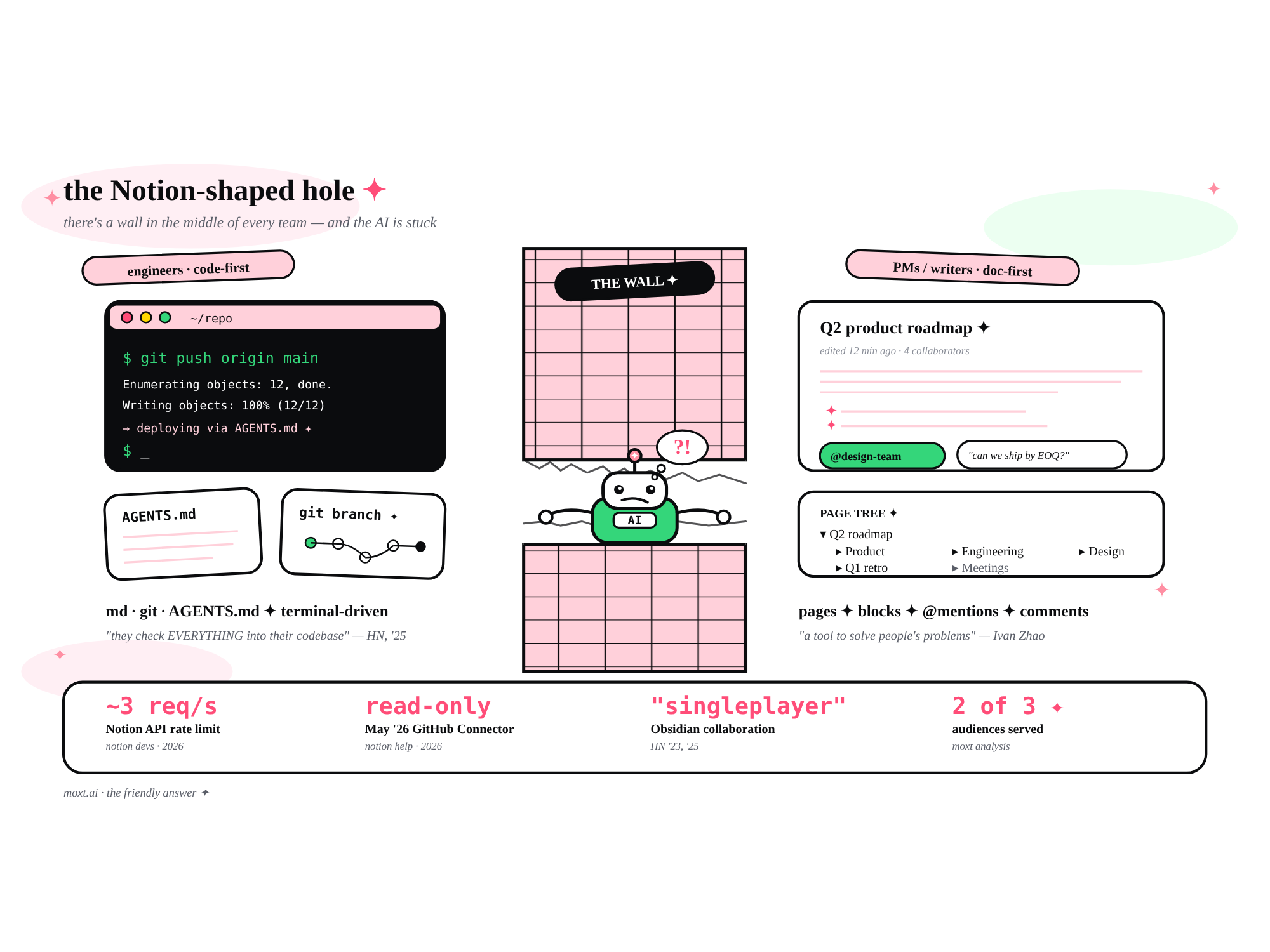
The complaint that shows up across user posts is not that Notion is bad. It is that Notion sits on the wrong side of a wall.
A Hangzhou-based studio, Zhima Nüwu, shared on Xiaohongshu (China's lifestyle and content platform) the moment her workflow stopped working:
"I write in Markdown locally. I use GitHub as my source of truth. I use a coding agent like Claude Code to drive my AI workflows. But all of that has to be synced back to Notion so a non-technical collaborator can join in. Two workflows became fragmented — collaboration broke into pieces."
That diagnosis is one Hangzhou studio's. Listen to a Western engineer in an Ask HN thread titled "Leaving Notion, Codebase as a Wiki?" and the read is identical:
"They check in EVERYTHING into their codebase. Not just plan.md files… but investor_meeting.md, user_feedback.md, growth_strategy.md, TODOs.md… it's way way simpler to just dump stuff into the codebase, let Git handle the collaboration aspect, and let Opus/Sonnet + Claude Code retrieve info and manage it." — Hacker News, "Leaving Notion, Codebase as a Wiki?" thread
Two engineers, two continents, the same migration. The complaint is not about Notion's features — it is about a wall that runs through the middle of every modern team:
- Engineers want files. Markdown, Git history,
AGENTS.mdrules, terminal-driven agents. - Non-engineers want pages. Drag-and-drop, comments, page mentions — the things Notion does well.
- AI agents want both. They need to read code AND read product specs in one place to be useful.
Notion can host page #1 and page #2. It cannot host a Git repo or invoke a deployment. Teams that try to bridge it through Notion's API hit a second wall fast: the public API is rate-limited to roughly three requests per second per integration (Notion Developers, Request limits) — fine for occasional sync, painful for an agent operating continuously.
Notion's recent move: the May 2026 GitHub AI Connector
Notion's own answer arrived in May 2026 with the GitHub AI Connector — Notion AI can now reference your repos, issues, and PRs when you ask. It closes a real gap. The connector is read-only, though: it lets you ask Notion about your repo, not ask Notion AI to update the repo. The wall is shorter. It hasn't come down.
The three-way problem: technical, non-technical, and AI
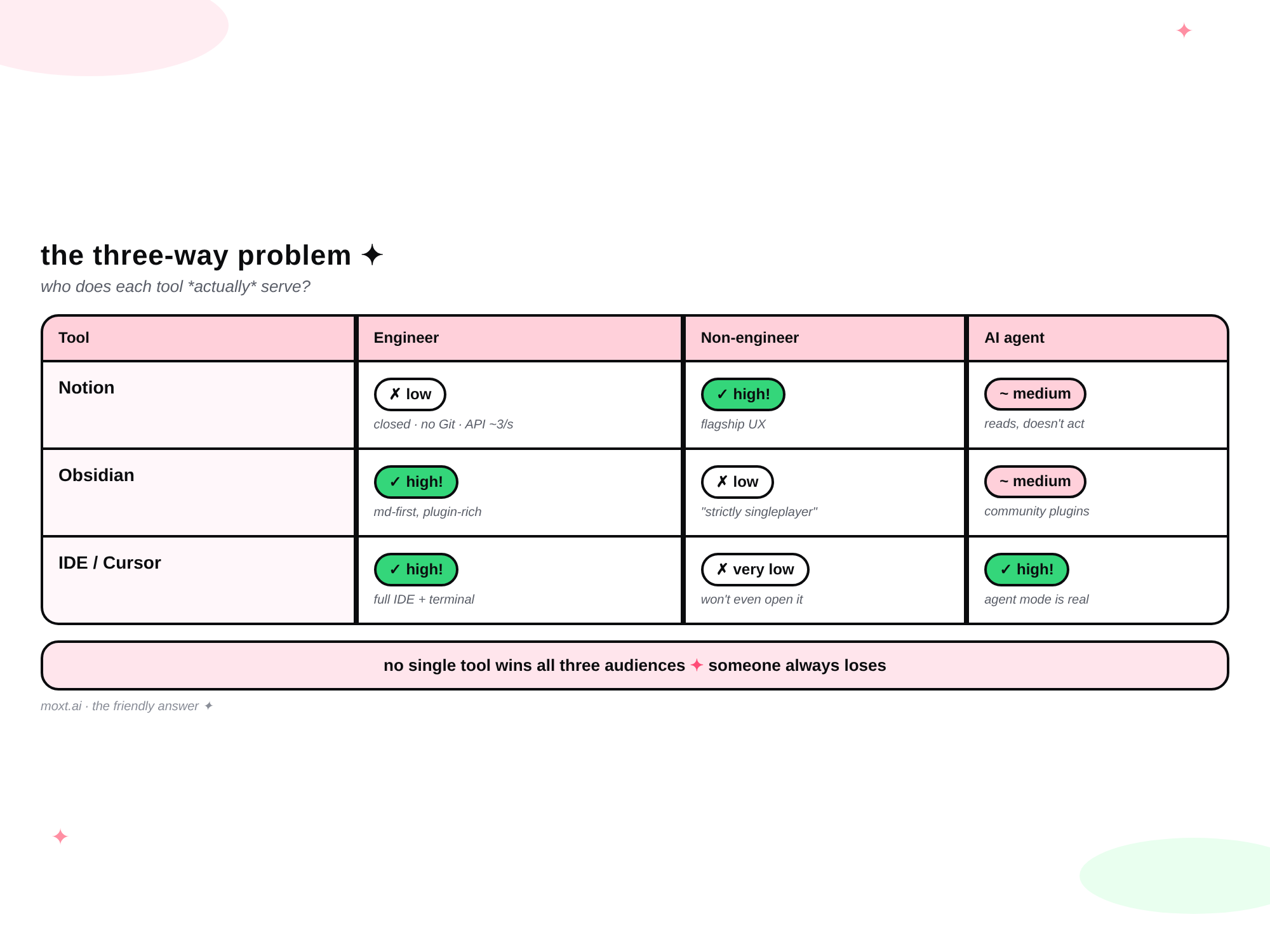
Most "Notion alternative" lists evaluate tools on the wrong axis. They rank features (databases, blocks, templates) when the actual selection problem is which audience the tool privileges. Here is how the three classic options serve the three audiences:
| Tool | Engineer-friendly | Non-engineer-friendly | AI-agent-friendly |
|---|---|---|---|
| Notion | Low — closed format, no Git, API rate-limited (~3 req/s) | High — flagship UX for this audience | Medium — Notion AI exists; new GitHub Connector reads but does not act |
| Obsidian | High — Markdown-first, plugin-rich, local-first | Low — file-system mental model required | Medium — community plugins, no native multi-agent |
| VS Code / Cursor / Claude Code | High — full IDE, terminal, extensions | Very low — most non-engineers won't open it | High in agent mode, but unusable as a shared workspace for writers |
The "just use Obsidian" reflex collapses the moment you read what its own users say about teamwork. From a 2023 Hacker News thread on Obsidian collaboration:
"Obsidian does not support collaboration. It's a fantastic tool but strictly singleplayer."
Another HN comment two years later confirms it has not changed:
"Almost all ways to sync Obsidian has a problem with multiple people editing the same file."
So the verdict from independent voices on two sides of the world is the same conclusion every mixed team eventually reaches: none of these three solves the three-way problem alone. You either pick a tool that excludes one of your audiences, or you run two tools and pay the synchronization tax forever.
What an AI-native workspace actually does differently
An AI-native workspace is a collaboration tool where AI agents are first-class teammates — they have their own scope, persistent context, and the ability to read repositories and act on connected systems like GitHub. This is distinct from a document tool with a Generate button (e.g. Notion AI).
The category is being named because builders themselves keep reaching for the same diagnosis. From a Show HN post by the Tandem team:
"Current tools (Google Docs, Notion, etc.) were designed for human-to-human collaboration. When I copy-paste Claude's suggestions into a doc, all attribution is lost."
And from a separate Show HN by the Moment team:
"We're working on Notion alternative which is (1) rich and collaborative, but (2) also just plain-old Markdown files, stored in git… coding agents (claude, amp, copilot, opencode, etc.) are good enough now."
When founders building in this space and engineers leaving the space converge on the same architecture — markdown + git + a real AI teammate — that is a signal worth taking seriously.
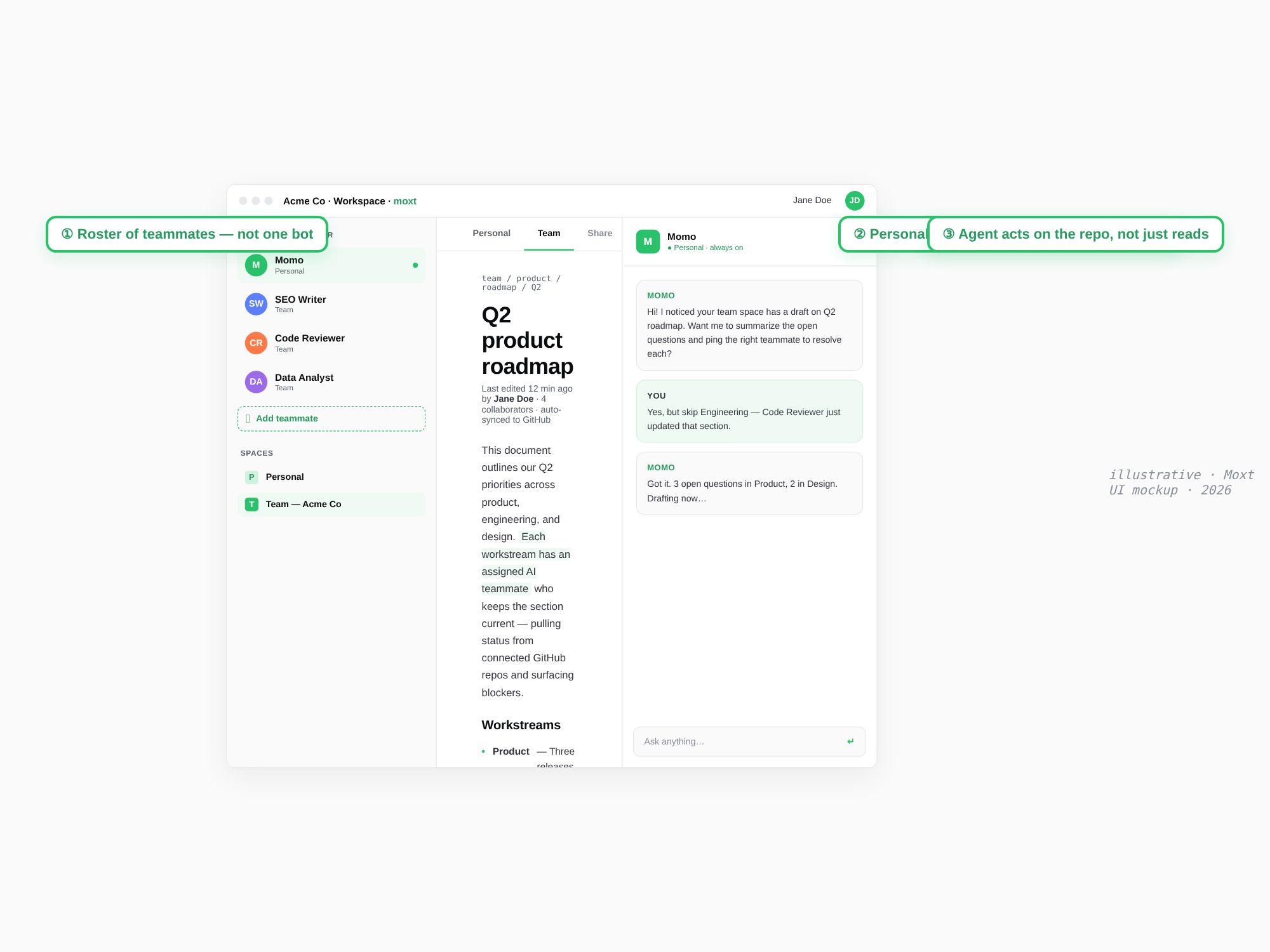
In her Xiaohongshu post, Zhima Nüwu walked through the three-pane workflow that replaced her broken setup:
"The screen splits into three: your document workspace in the middle, your AI agent on the right (it's called Momo, your personal assistant), and a marketplace of AI teammates you can add to your team. Team space is what every collaborator sees. Personal space is my own knowledge base — myself as context."
Three details from that walk-through are the design pattern of this whole category:
- Two-layer context: a personal space (your notes, drafts) the AI uses as your context, plus a team space every teammate sees. The AI knows the difference. Notion's pages all live at one level.
- Agents-as-teammates instead of agents-as-features: you add specialized AI teammates from a marketplace, the way you invite a designer or a PM. Notion AI is one assistant; AI-native workspaces are a roster. (See Moxt's framing of the AI teammate concept.)
- Repo-aware actions: the agent reads
AGENTS.mdto learn the rules of a project, then acts — places an article in the right directory, registers it in an index, and triggers a deploy.
The concrete payoff Zhima Nüwu showed in the same post: a non-technical contributor can write an article inside the workspace and ask the AI to publish it. The AI reads AGENTS.md, places the file in the right folder, registers the index, and pushes to GitHub. The website updates. Nobody opened a terminal.
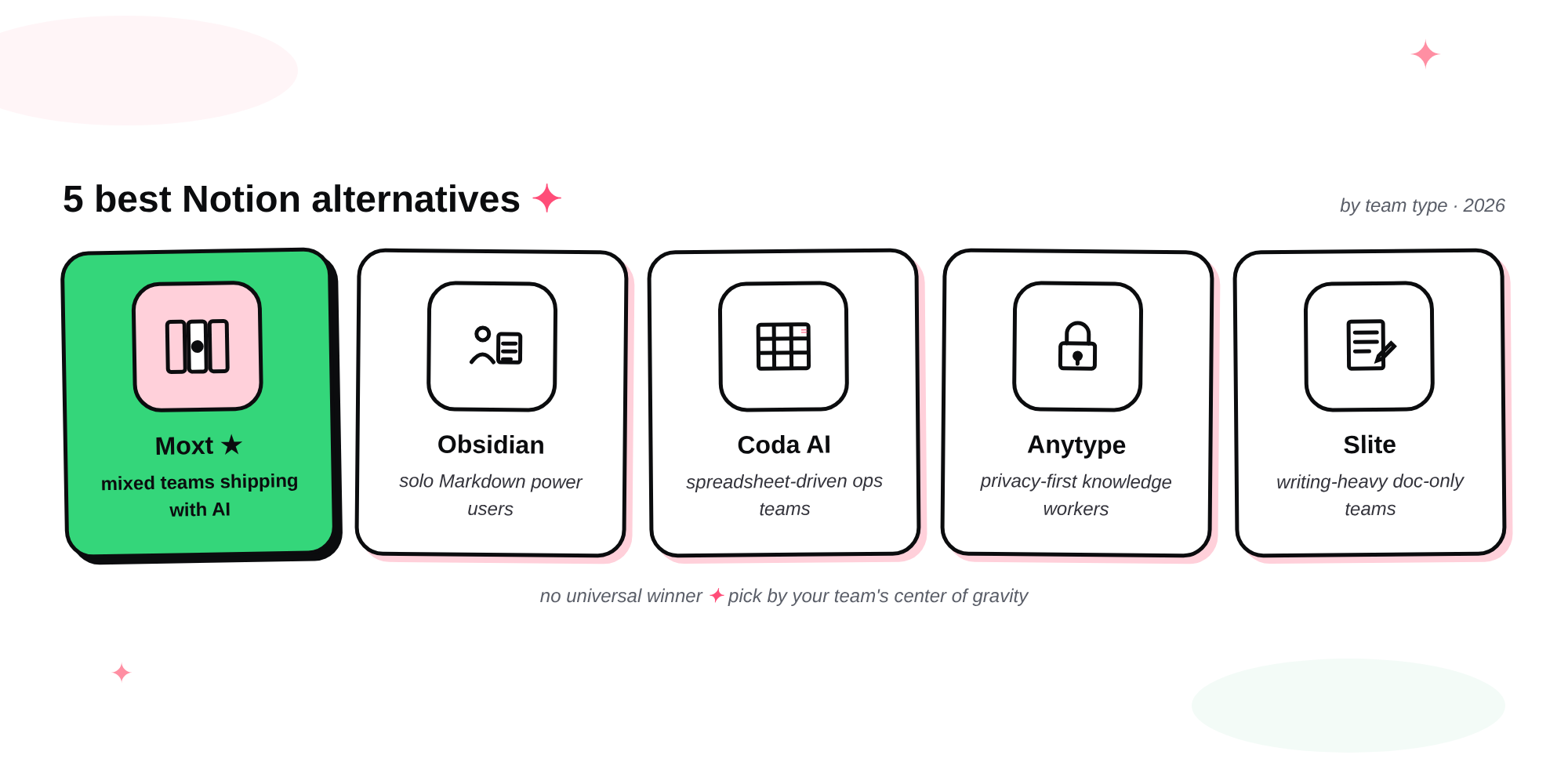
The 5 best Notion alternatives in 2026
Honest comparison, with the team type each one is genuinely best for. No tool wins everything.
| Tool | Best for | Mixed tech + non-tech | Native AI agents | GitHub round-trip (act, not just read) | Free tier |
|---|---|---|---|---|---|
| Moxt | Mixed teams shipping with AI | ✅ Yes | ✅ Multi-agent (roster) | ✅ Native (act + read) | Yes |
| Obsidian | Solo Markdown power users | ❌ Engineer-only | ⚠️ Plugins | ⚠️ Community plugins | Yes |
| Coda AI | Spreadsheet-driven ops teams | ⚠️ Partial | ⚠️ One assistant | ❌ No | Yes |
| Anytype | Privacy-first knowledge workers | ⚠️ Partial | ❌ No | ❌ No | Yes |
| Slite | Writing-heavy doc-only teams | ⚠️ Partial | ⚠️ One assistant | ❌ No | Limited |
1. Moxt — for mixed tech + non-tech teams using AI agents
Moxt is the workspace category Zhima Nüwu walked through above: three-pane layout (docs / your AI assistant / teammate marketplace), team and personal spaces, and AI teammates that can read a repo and act. If your team has any combination of engineers writing Markdown locally, non-engineers writing in a doc tool, and AI agents driving real work, Moxt is the only tool on this list designed for that intersection.
Where Moxt is not the best pick: solo Markdown writers who never collaborate (Obsidian wins), teams whose primary workflow is structured tables (Coda wins), or organizations with a hard local-only / privacy-first requirement (Anytype wins).
→ Try Moxt with AI teammates and start free.
2. Obsidian — for solo Markdown power users
The reigning answer to "I want my notes in plain files I own forever." Local-first, Markdown-native, plugin ecosystem so large it can become a hobby. Pair it with a coding agent and an engineer can run circles around any cloud doc tool — alone.
Where it breaks: as the HN voices above make plain, the second person on your team will quietly switch back to Google Docs. Obsidian is a singleplayer tool.
3. Coda AI — for spreadsheet-driven ops teams
Coda's strength has always been the doc-database hybrid: pages that are also tables that are also apps. Coda AI was launched out of beta in late 2023 (per Computerworld coverage of the Coda AI launch) and has since become a respectable single AI assistant. If your team's center of gravity is structured data, Coda is excellent.
Where it breaks: Coda's AI is one assistant, not a roster. It does not connect to GitHub for round-trip workflows.
4. Anytype — for privacy-first knowledge workers
Local-first, encrypted, open-source. If "my company will never let us put strategy docs on someone else's server" is your constraint, Anytype is the most polished local-first option in 2026.
Where it breaks: there are no native AI agents. By design.
5. Slite — for writing-heavy doc-only teams
A clean doc tool with a single AI assistant tuned for writing. Cheaper than Notion at scale, with a reading-focused UX some teams prefer.
Where it breaks: same shape as Coda's limitation — one AI, no agent ecosystem, no Git.
How to pick: a 4-question decision tree
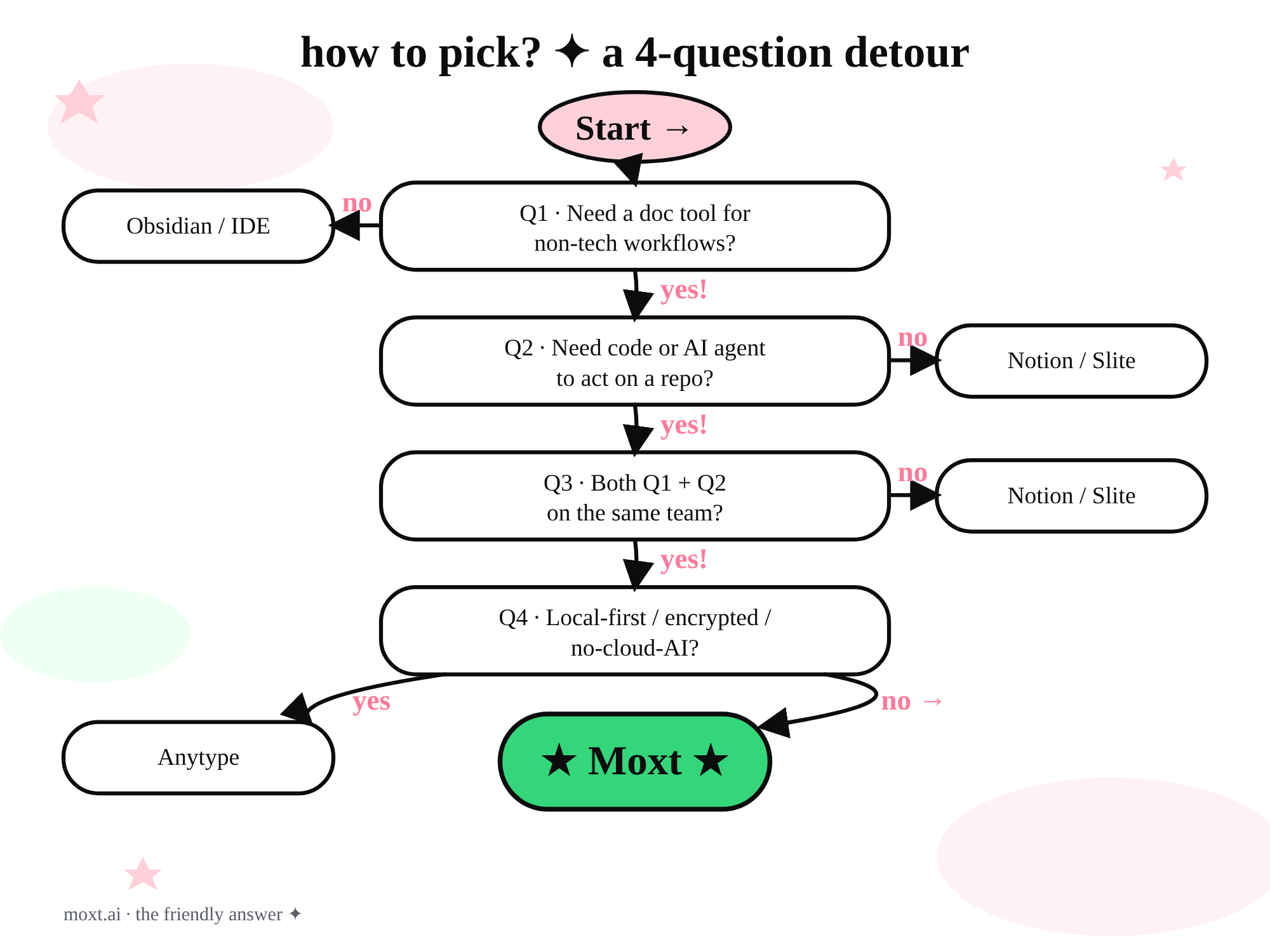
If a comparison table is too dense, walk these in order:
- Does any teammate need a doc tool that hosts non-technical workflows (writing, comments, page mentions)? No → Obsidian or an IDE-based setup is enough. Skip the rest.
- Does any teammate write code or need an AI agent to act on a repo (deploy, file PRs, update docs in Git)? No → Notion or Slite still works. The rest of this article is not your problem yet.
- Do both #1 and #2 apply to the same team? Yes → You are the audience for AI-native workspaces. Continue to #4.
- Do you need local-first / encrypted / no-cloud-AI? Yes → Anytype. No → Moxt is the most direct fit, with Coda as a backup if your work is more table-shaped than agent-shaped.
FAQ
What is the best alternative to Notion in 2026?
It depends on team composition. For solo Markdown users, Obsidian. For doc-only teams that just want a leaner Notion, Slite. For teams that combine engineers, non-engineers, and AI agents on the same canvas, Moxt is the most direct fit.
What is a Notion AI alternative for collaboration?
A Notion AI alternative for collaboration is a workspace where AI is not a single sidebar assistant but a roster of agents multiple teammates can interact with at once, with separate personal and team contexts. Moxt, Coda AI, and Slite all sit in this neighborhood; Moxt is the only one with a multi-agent roster and native GitHub round-trip as of May 2026.
Is there a Notion alternative built for AI?
Yes — the "AI-native workspace" category includes Moxt, Coda AI, and several emerging tools (Tandem, Moment, and others surfacing in Show HN threads). The defining trait is that AI agents are first-class teammates with their own scope and tools, not a single sidebar assistant bolted onto a doc editor.
What is the best free Notion alternative?
For solo Markdown users, Obsidian is the strongest free option. For teams that need AI agents and GitHub round-trip, Moxt has a free tier covering the core three-pane workflow. Anytype is a strong free option if local-first is required.
Can a non-technical user publish to GitHub through an AI agent?
In a Notion-style tool, no — even with Notion's May 2026 GitHub AI Connector, the connector is read-only. In an AI-native workspace where the agent can read a repo's AGENTS.md rules, yes — the user describes the publish action in plain language, and the agent handles the file placement, index registration, and commit. This is the workflow Zhima Nüwu walked through in her Xiaohongshu post.
Is "ai teammate" a real category or a marketing term?
It is becoming a real category. "AI teammate" describes an AI agent with a scoped role, persistent context, and the ability to act on connected systems — distinct from a chatbot or a one-shot assistant. Search volume is growing in 2026 (ai teammate 40/mo, ai teammates 260/mo per Semrush, May 2026), and the term is being used the way "designer" or "PM" is used: a role you configure, not a feature you toggle.
The Notion conversation, reopened
Notion is not over. Notion is the right answer to the question Notion was built for, and its May 2026 GitHub AI Connector shows the team is paying attention. But the question changed. Teams now have a third member — the AI agent — who needs to sit at the table with the engineers and the writers.
If your team has all three audiences in the room, "what's the best Notion alternative?" stops being a feature comparison and becomes an architecture choice: pick the tool whose core surface treats engineers, non-engineers, and AI agents as equal citizens.
Build your AI-native workspace — start free
About this article
This article is part of an ongoing series at Moxt where we collect first-hand workflow stories from real teams using AI-native workspaces and turn them into honest, comparison-driven SEO content. We cite sources by name when we have permission, keep originals on file, and follow Google Search Central's Helpful, Reliable, People-First Content guidance on transparency.
The lead source for the Hangzhou studio story is a public Xiaohongshu post by Zhima Nüwu, dated April 2025. We have referenced and quoted it twice above. The corroborating Western voices are from Hacker News threads and Show HN posts dated 2023–2026, cited inline by item ID.
If you have a workflow story we should profile, reach out — we keep a submission inbox.
Zhima Nüwu (Hangzhou Xiaoshan Zhima Nüwu Studio) is a Moxt partner under our content program (contract effective March 2026). We reference her publicly shared workflow with permission and attribution. Original images, screenshots, and video frames remain the property of the original author and are not reproduced in this article.
Cover and inline illustrations on this page are produced by Moxt's design system, including AI-assisted generation.